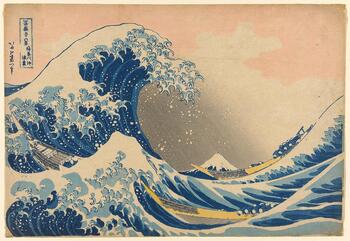
In November 2025, a version of Katsushika Hokusai’s Under the Great Wave off Kanagawa sold at Sotheby’s Hong Kong for HK$21.7 million — the highest price ever paid for the iconic print. The figure drew predictable attention, but price alone cannot explain the hold this image continues to exert. Japanese woodblock prints are plentiful and often extraordinary. The ukiyo-e tradition produced a vast world of beauty — landscapes, city scenes, actors, courtesans, and seascapes rendered with remarkable discipline and grace. Yet among this abundance, The Great Wave stands apart. It is no longer merely a famous artwork. It has become one of the defining images through which modern people interpret instability, scale, and the feeling of living beneath forces larger than themselves.
What distinguishes this work is not just craftsmanship, rarity, or fame. It is its precision in capturing a psychological reality that feels unmistakably contemporary.
Three narrow fishing boats move across churning water as a vast wave rises overhead, its crest frozen in the instant before collapse. The men do not battle the sea; they brace for it. In the distance, small and unwavering, Mount Fuji remains still, its quiet geometry anchoring the entire scene. The moment is tense but not theatrical. There is danger without exaggeration, energy without chaos. The composition is both dramatic and disciplined.
That restraint is essential. The image does not shout; it measures. It does not glorify struggle; it renders it with clarity.
The modern world increasingly feels like a version of this seascape. Economic volatility, technological acceleration, civic uncertainty, environmental strain, and cultural fragmentation have produced a quiet sense of exposure. Many people move through systems they cannot fully understand and forces they cannot meaningfully control. We experience motion without mastery, pressure without clear authorship. Hokusai gave visual form to that sensation long before it had a name.
The wave is not simply water. It is disruption itself — impersonal, relentless, indifferent. The boats are not merely fishermen; they are ordinary people and communities navigating conditions that demand endurance rather than heroism. And Mount Fuji, distant yet immovable, represents something increasingly scarce: steadiness. A fixed point in a world defined by churn.
What makes The Great Wave singular is its refusal to romanticize control. It offers no fantasy of dominance over nature. There is no triumph here, no promise of conquest. Instead, it presents humility as wisdom. It suggests that survival depends less on bravado than on proportion, awareness, and disciplined posture in the face of overwhelming force.
Many Japanese prints celebrate pleasure, seasonal change, or the fleeting beauty of everyday life. Many are visually stunning. But this one engages something more enduring: the strain of existing inside immense systems that neither indulge nor destroy us outright. It reveals what it means to persist under pressure without illusion.
There is also something unmistakably modern in the viewer’s position. We do not hover above the scene, safely detached. We are placed inside it. Our eye travels along the boats, feels the looming presence of the wave, and rests briefly on the distant calm of Fuji. That immersive perspective mirrors contemporary life, where individuals are no longer buffered by distance or hierarchy but drawn directly into economic, social, and environmental turbulence.
Yet for all its immediacy, the image insists on coherence. The wave is wild, but not formless. The threat is immense, but intelligible. Everything remains legible, held within careful design. Even at the brink, there is structure. That, too, feels instructive: motion need not dissolve into disorder, and danger need not become collapse.
The record-setting sale only sharpens the irony. An image that so powerfully illustrates modesty, vulnerability, and proportion now circulates as a high-value luxury object. But despite its absorption into the marketplace of prestige and spectacle, it refuses decoration. It still unsettles. It still instructs. Its meaning has not thinned with repetition; it has deepened.
Most images become ornamental. A few become fashionable. Almost none retain explanatory power. The Great Wave does. It continues to clarify rather than soothe, to remind rather than distract.
Japanese prints may be many and magnificent. But this one occupies a different category. It has become a visual shorthand for what it feels like to live within vast, impersonal forces and still attempt to keep one’s bearings. Its power lies not in affirming modern confidence, but in tempering it — insisting, quietly and with precision, that balance matters, that limits exist, and that steadiness remains vital even when the sea rises.
In an age addicted to speed, scale, and spectacle, The Great Wave offers something increasingly rare: proportion. It does not promise safety, but it does offer clarity. And in doing so, it reminds us that survival — personal, civic, and cultural — depends not on domination, but on the disciplined ability to face what we cannot command and remain upright anyway.
That is why, nearly two centuries later, this image still commands the modern imagination — not because it flatters our sense of power, but because it quietly tells us the truth.
Samuel J. Abrams is a professor of politics at Sarah Lawrence College, a senior fellow at the American Enterprise Institute, and a scholar with the Sutherland Institute.
Photo: Art Institute of Chicago, under CC 1.0 Universal Public Domain Dedication.
 Email this Story